Star Wars: The Force Unleashed, making the Force targetable & upgradeable
My Role
UX Design Lead
Product Type
Videogame
The Force Unleashed earned critical praise for its cinematic ambition and physics-based implementation of Force powers, ultimately selling over 9 million copies. I was responsible for inventing, designing the game's interface to meet platform standards for presentation and localization. This included systems for subtitles, progression, and combat. Using a Lua-based UI framework developed by our engineers, I built and animated menus, screens and displays.
A stormtrooper is hurled into a TIE fighter, destroying both on impact. Directional damage and reactive metering on the HUD overlay subsequently show the player being damaged by a nearby enemy
Gameplay Video PlayStation3
Developer & PUBLISHER
Platforms
Lifecycle
Released 2008
Key Skills & Tools
In-house Game Tooling, Anark Studio, Lua Scripting, Photoshop, Illustrator, Prototyping
Credits
Game Director Haden Blackman Art Director Matt Omernick Game Design John Stafford, Rich Davis, Shawn Pitman, Cameron Suey Interface Design Gary Boodhoo, Brian Lui Visual Effects Timothy Nice Interface Engineering Stephen Schlueter, Jeffrey Pyacek, Shawn McLean Production Isa Anne Stamos, Matthew J. Fillbrandt, Julio Torres, Franklin Alioto Localization Hiromi Okamoto, Gabriel Bootz Quality Assurance Julian James, Troy Sims
Star Wars: The Force Unleashed, making the Force targetable & upgradeable
My Role
UX Design Lead
Product Type
Videogame
The Force Unleashed earned critical praise for its cinematic ambition and physics-based implementation of Force powers, ultimately selling over 9 million copies. I was responsible for inventing, designing the game's interface to meet platform standards for presentation and localization. This included systems for subtitles, progression, and combat. Using a Lua-based UI framework developed by our engineers, I built and animated menus, screens and displays.
A stormtrooper is hurled into a TIE fighter, destroying both on impact. Directional damage and reactive metering on the HUD overlay subsequently show the player being damaged by a nearby enemy
Gameplay Video PlayStation3
Developer & PUBLISHER
Platforms
Lifecycle
Released 2008
Key Skills & Tools
In-house Game Tooling, Anark Studio, Lua Scripting, Photoshop, Illustrator, Prototyping
Credits
Game Director Haden Blackman Art Director Matt Omernick Game Design John Stafford, Rich Davis, Shawn Pitman, Cameron Suey Interface Design Gary Boodhoo, Brian Lui Visual Effects Timothy Nice Interface Engineering Stephen Schlueter, Jeffrey Pyacek, Shawn McLean Production Isa Anne Stamos, Matthew J. Fillbrandt, Julio Torres, Franklin Alioto Localization Hiromi Okamoto, Gabriel Bootz Quality Assurance Julian James, Troy Sims
Star Wars: The Force Unleashed, making the Force targetable & upgradeable
My Role
UX Design Lead
Product Type
Videogame
The Force Unleashed earned critical praise for its cinematic ambition and physics-based implementation of Force powers, ultimately selling over 9 million copies. I was responsible for inventing, designing the game's interface to meet platform standards for presentation and localization. This included systems for subtitles, progression, and combat. Using a Lua-based UI framework developed by our engineers, I built and animated menus, screens and displays.
A stormtrooper is hurled into a TIE fighter, destroying both on impact. Directional damage and reactive metering on the HUD overlay subsequently show the player being damaged by a nearby enemy
Gameplay Video PlayStation3
Developer & PUBLISHER
Platforms
Lifecycle
Released 2008
Key Skills & Tools
In-house Game Tooling, Anark Studio, Lua Scripting, Photoshop, Illustrator, Prototyping
Credits
Game Director Haden Blackman Art Director Matt Omernick Game Design John Stafford, Rich Davis, Shawn Pitman, Cameron Suey Interface Design Gary Boodhoo, Brian Lui Visual Effects Timothy Nice Interface Engineering Stephen Schlueter, Jeffrey Pyacek, Shawn McLean Production Isa Anne Stamos, Matthew J. Fillbrandt, Julio Torres, Franklin Alioto Localization Hiromi Okamoto, Gabriel Bootz Quality Assurance Julian James, Troy Sims
Star Wars: The Force Unleashed, making the Force targetable & upgradeable
My Role
UX Design Lead
Product Type
Videogame
The Force Unleashed earned critical praise for its cinematic ambition and physics-based implementation of Force powers, ultimately selling over 9 million copies. I was responsible for inventing, designing the game's interface to meet platform standards for presentation and localization. This included systems for subtitles, progression, and combat. Using a Lua-based UI framework developed by our engineers, I built and animated menus, screens and displays.
A stormtrooper is hurled into a TIE fighter, destroying both on impact. Directional damage and reactive metering on the HUD overlay subsequently show the player being damaged by a nearby enemy
Gameplay Video PlayStation3
Developer & PUBLISHER
Platforms
Lifecycle
Released 2008
Key Skills & Tools
In-house Game Tooling, Anark Studio, Lua Scripting, Photoshop, Illustrator, Prototyping
Credits
Game Director Haden Blackman Art Director Matt Omernick Game Design John Stafford, Rich Davis, Shawn Pitman, Cameron Suey Interface Design Gary Boodhoo, Brian Lui Visual Effects Timothy Nice Interface Engineering Stephen Schlueter, Jeffrey Pyacek, Shawn McLean Production Isa Anne Stamos, Matthew J. Fillbrandt, Julio Torres, Franklin Alioto Localization Hiromi Okamoto, Gabriel Bootz Quality Assurance Julian James, Troy Sims
Targeting
Effortless control
Targeting
Effortless control
Targeting
Effortless control
Targeting
Effortless control
Throwing and moving things (with The Force) was effortless and intuitive thanks to a targeting system that prioritized a hierarchy of nearby objects without requiring precise aim. I prototyped the Force Targeting system in-engine using Lua, running on PlayStation 3 hardware to test reactivity and timing.
Throwing and moving things (with The Force) was effortless and intuitive thanks to a targeting system that prioritized a hierarchy of nearby objects without requiring precise aim. I prototyped the Force Targeting system in-engine using Lua, running on PlayStation 3 hardware to test reactivity and timing.
Throwing and moving things (with The Force) was effortless and intuitive thanks to a targeting system that prioritized a hierarchy of nearby objects without requiring precise aim. I prototyped the Force Targeting system in-engine using Lua, running on PlayStation 3 hardware to test reactivity and timing.
Throwing and moving things (with The Force) was effortless and intuitive thanks to a targeting system that prioritized a hierarchy of nearby objects without requiring precise aim. I prototyped the Force Targeting system in-engine using Lua, running on PlayStation 3 hardware to test reactivity and timing.
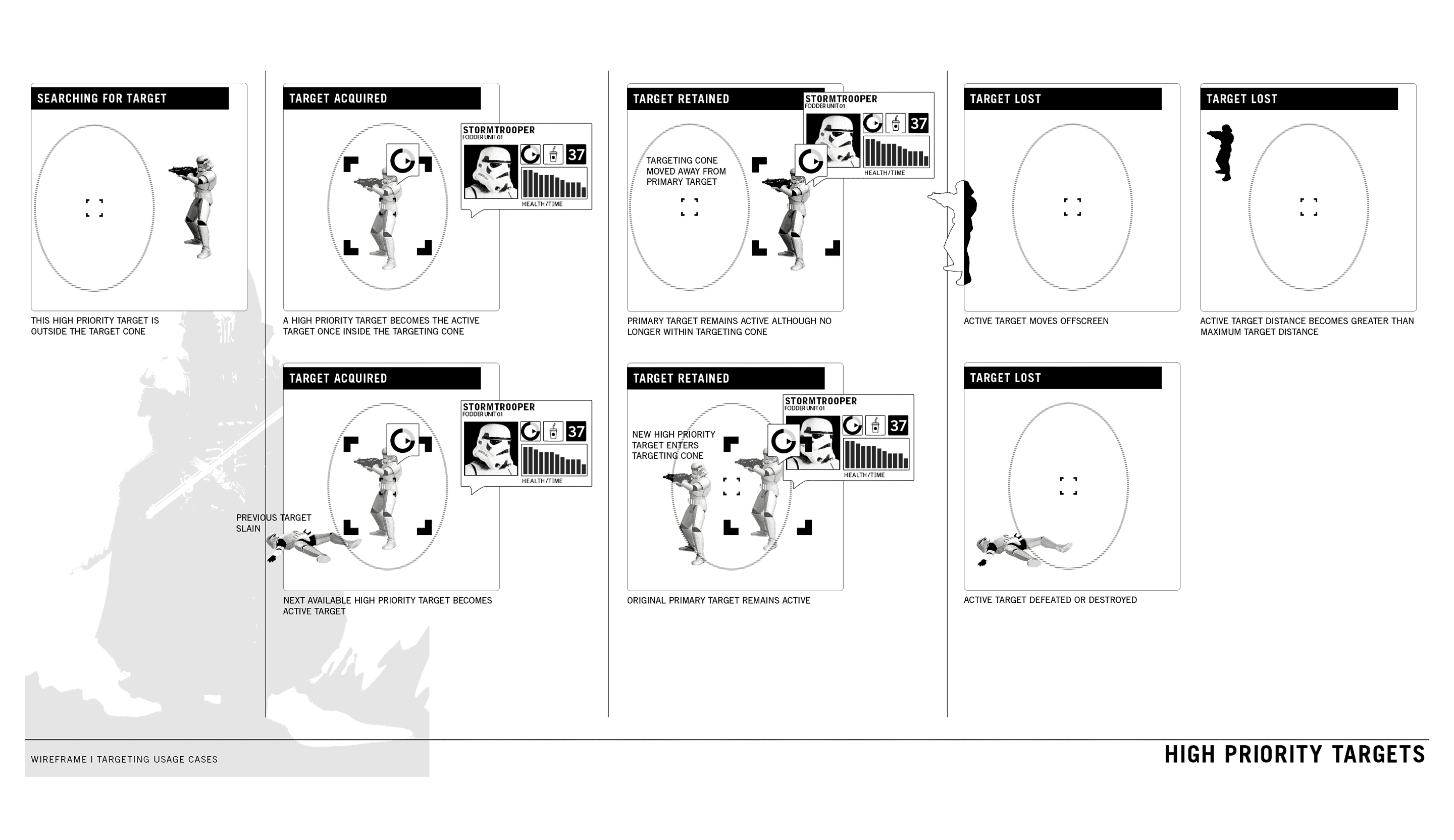
High-priority targeting rules showing how the system selects the player’s primary target, and how priority shifts as conditions change.
In-engine Lua prototype Gary Boodhoo
High-priority targeting rules showing how the system selects the player’s primary target, and how priority shifts as conditions change.
In-engine Lua prototype Gary Boodhoo
High-priority targeting rules showing how the system selects the player’s primary target, and how priority shifts as conditions change.
In-engine Lua prototype Gary Boodhoo
High-priority targeting rules showing how the system selects the player’s primary target, and how priority shifts as conditions change.
In-engine Lua prototype Gary Boodhoo
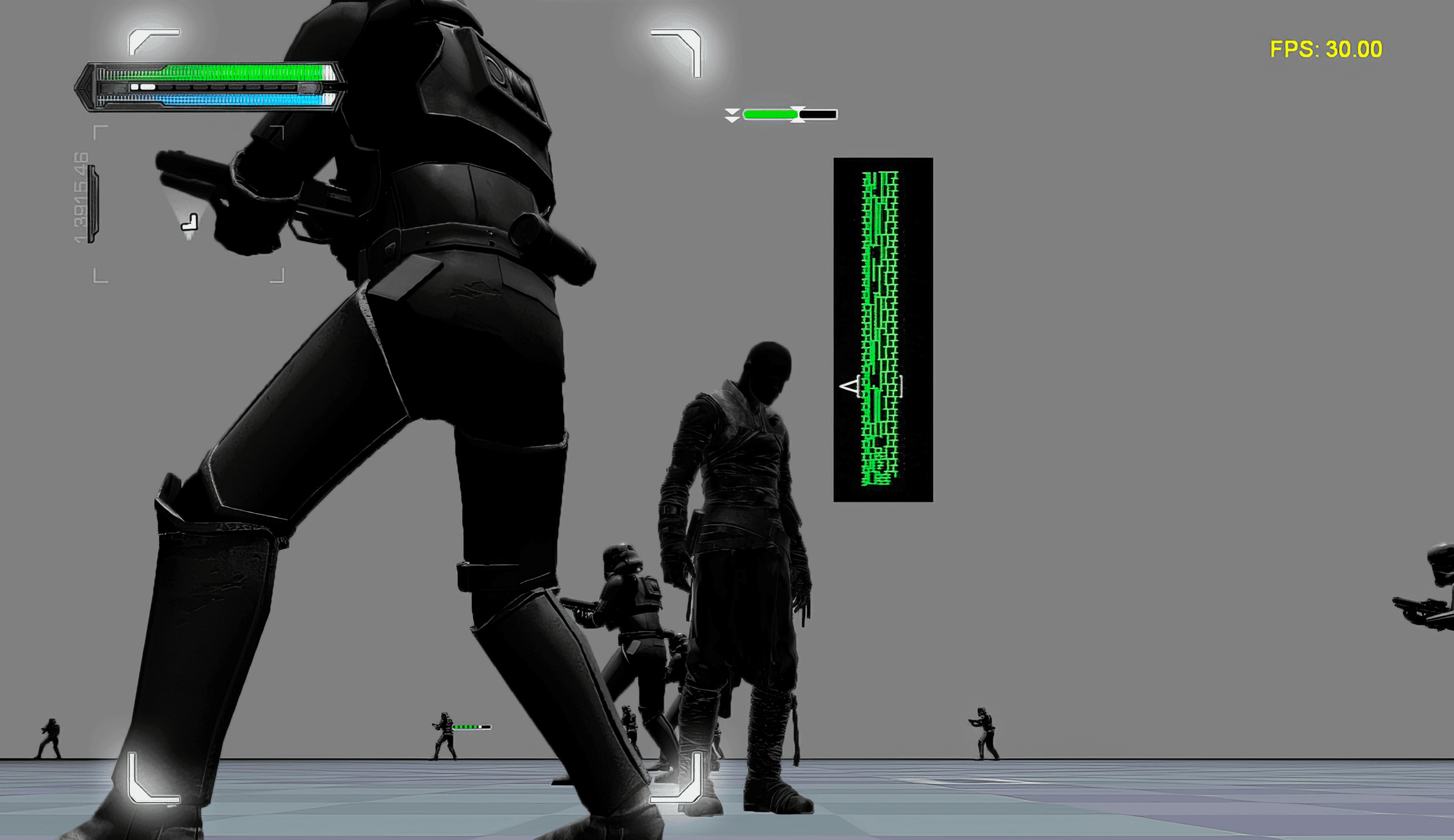
Targets are evaluated in world space, not screen space. Enemies can be closer to the camera than the player and still compete for priority. Built to validate targeting and UI behavior.
In-engine Lua prototype Gary Boodhoo
Targets are evaluated in world space, not screen space. Enemies can be closer to the camera than the player and still compete for priority. Built to validate targeting and UI behavior.
In-engine Lua prototype Gary Boodhoo
Targets are evaluated in world space, not screen space. Enemies can be closer to the camera than the player and still compete for priority. Built to validate targeting and UI behavior.
In-engine Lua prototype Gary Boodhoo
Targets are evaluated in world space, not screen space. Enemies can be closer to the camera than the player and still compete for priority. Built to validate targeting and UI behavior.
In-engine Lua prototype Gary Boodhoo
Throwing a crate to open a locked door with The Force. Cause and effect are communicated through the action itself.
Gameplay Video PlayStation3
Throwing a crate to open a locked door with The Force. Cause and effect are communicated through the action itself.
Gameplay Video PlayStation3
Throwing a crate to open a locked door with The Force. Cause and effect are communicated through the action itself.
Gameplay Video PlayStation3
Throwing a crate to open a locked door with The Force. Cause and effect are communicated through the action itself.
Gameplay Video PlayStation3
Visual Exploration
Decoding Imperial design principles
Visual Exploration
Decoding Imperial design principles
Visual Exploration
Decoding Imperial design principles
Visual Exploration
Decoding Imperial design principles
My early concepts were not a straight line to the final style. Their value was in pressure-testing references and identifying what would scale to production UI. We converged on Imperial design principles such as emptiness as luxury, strict structure, and sparse glowing controls that feel both technical and mystical. With those rules in place, I brought in a visual designer to execute the look while I drove the in game implementation.
My early concepts were not a straight line to the final style. Their value was in pressure-testing references and identifying what would scale to production UI. We converged on Imperial design principles such as emptiness as luxury, strict structure, and sparse glowing controls that feel both technical and mystical. With those rules in place, I brought in a visual designer to execute the look while I drove the in game implementation.
My early concepts were not a straight line to the final style. Their value was in pressure-testing references and identifying what would scale to production UI. We converged on Imperial design principles such as emptiness as luxury, strict structure, and sparse glowing controls that feel both technical and mystical. With those rules in place, I brought in a visual designer to execute the look while I drove the in game implementation.
My early concepts were not a straight line to the final style. Their value was in pressure-testing references and identifying what would scale to production UI. We converged on Imperial design principles such as emptiness as luxury, strict structure, and sparse glowing controls that feel both technical and mystical. With those rules in place, I brought in a visual designer to execute the look while I drove the in game implementation.
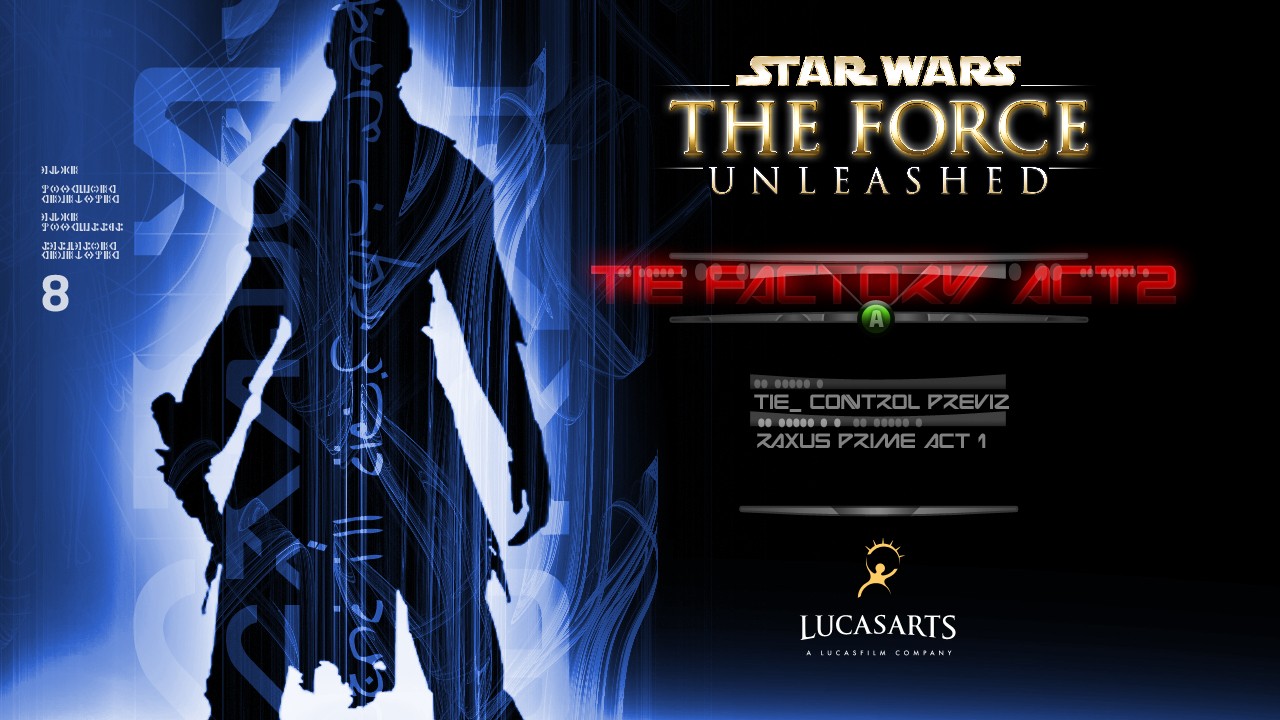
Early menu concept exploring ethereal composition, in-universe typography, and the Imperial use of empty space.
Visual Design Gary Boodhoo
Early menu concept exploring ethereal composition, in-universe typography, and the Imperial use of empty space.
Visual Design Gary Boodhoo
Early menu concept exploring ethereal composition, in-universe typography, and the Imperial use of empty space.
Visual Design Gary Boodhoo
Early menu concept exploring ethereal composition, in-universe typography, and the Imperial use of empty space.
Visual Design Gary Boodhoo
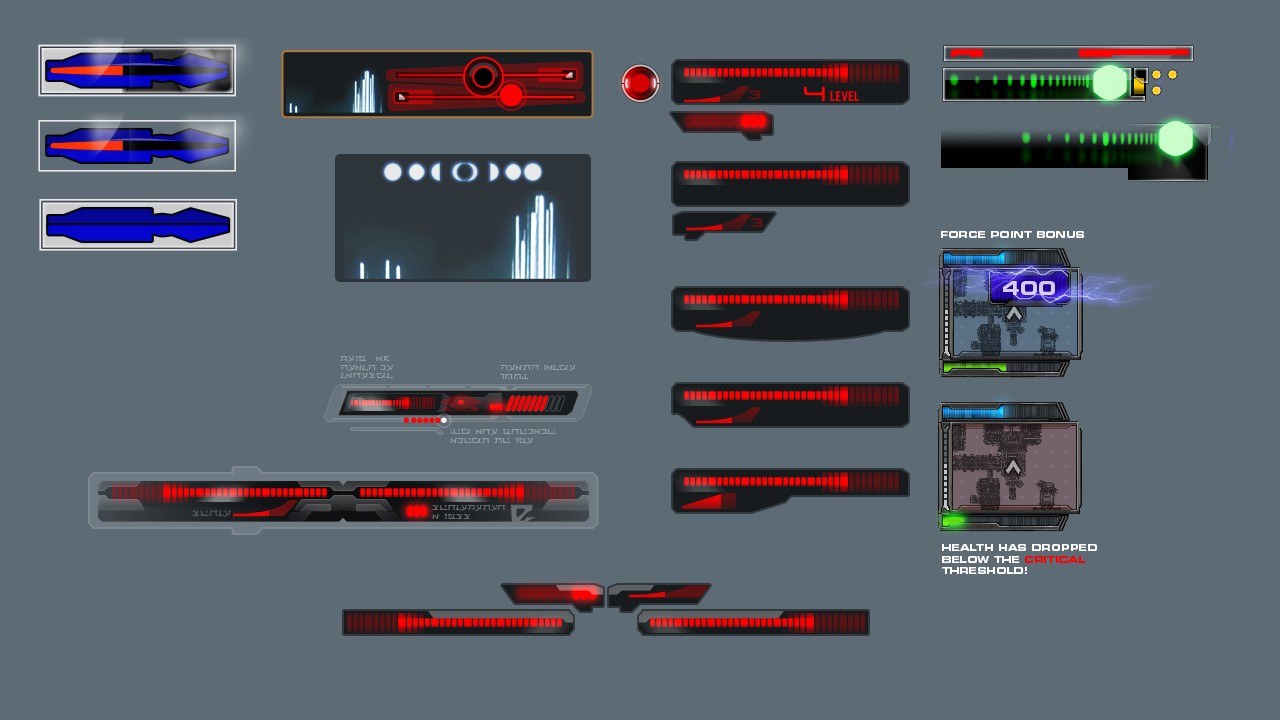
Preproduction metering concepts examining framing and visual emphasis for health, energy, and system states.
Visual Design Gary Boodhoo
Preproduction metering concepts examining framing and visual emphasis for health, energy, and system states.
Visual Design Gary Boodhoo
Preproduction metering concepts examining framing and visual emphasis for health, energy, and system states.
Visual Design Gary Boodhoo
Preproduction metering concepts examining framing and visual emphasis for health, energy, and system states.
Visual Design Gary Boodhoo
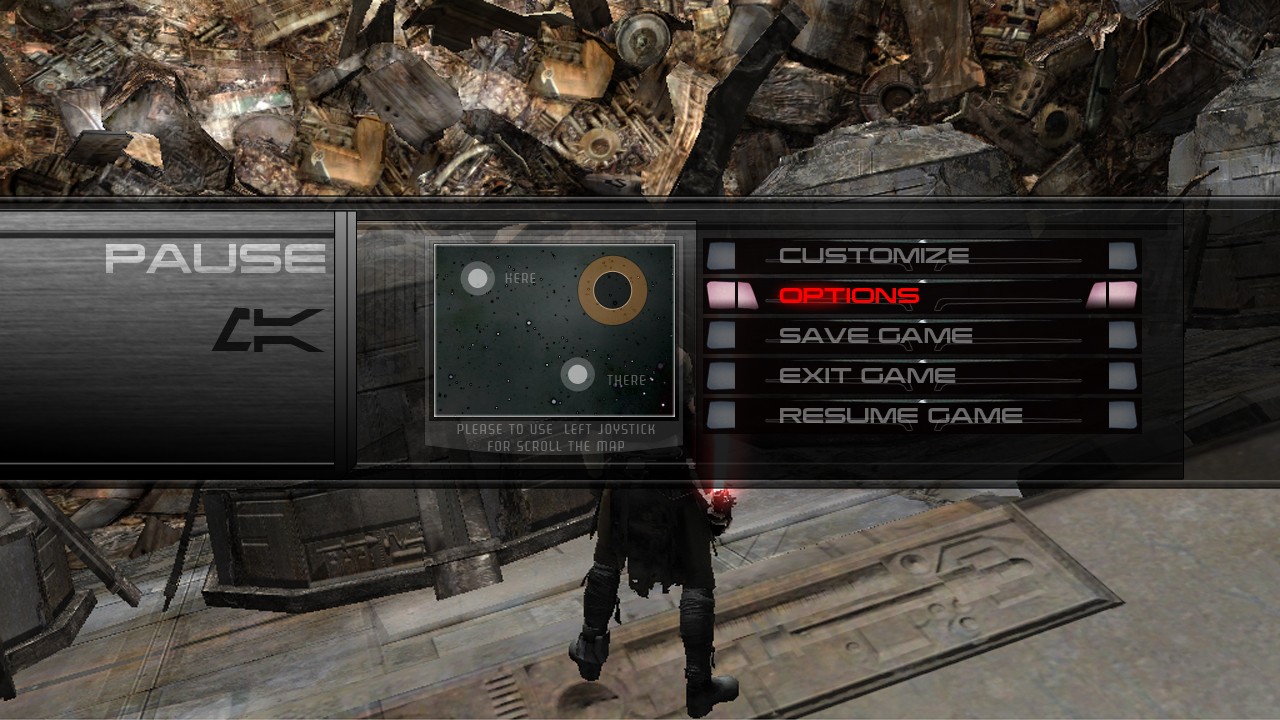
Pause menu concept built around a navigable, persistent map to maintain spatial awareness outside gameplay.
Visual Design Gary Boodhoo
Pause menu concept built around a navigable, persistent map to maintain spatial awareness outside gameplay.
Visual Design Gary Boodhoo
Pause menu concept built around a navigable, persistent map to maintain spatial awareness outside gameplay.
Visual Design Gary Boodhoo
Pause menu concept built around a navigable, persistent map to maintain spatial awareness outside gameplay.
Visual Design Gary Boodhoo
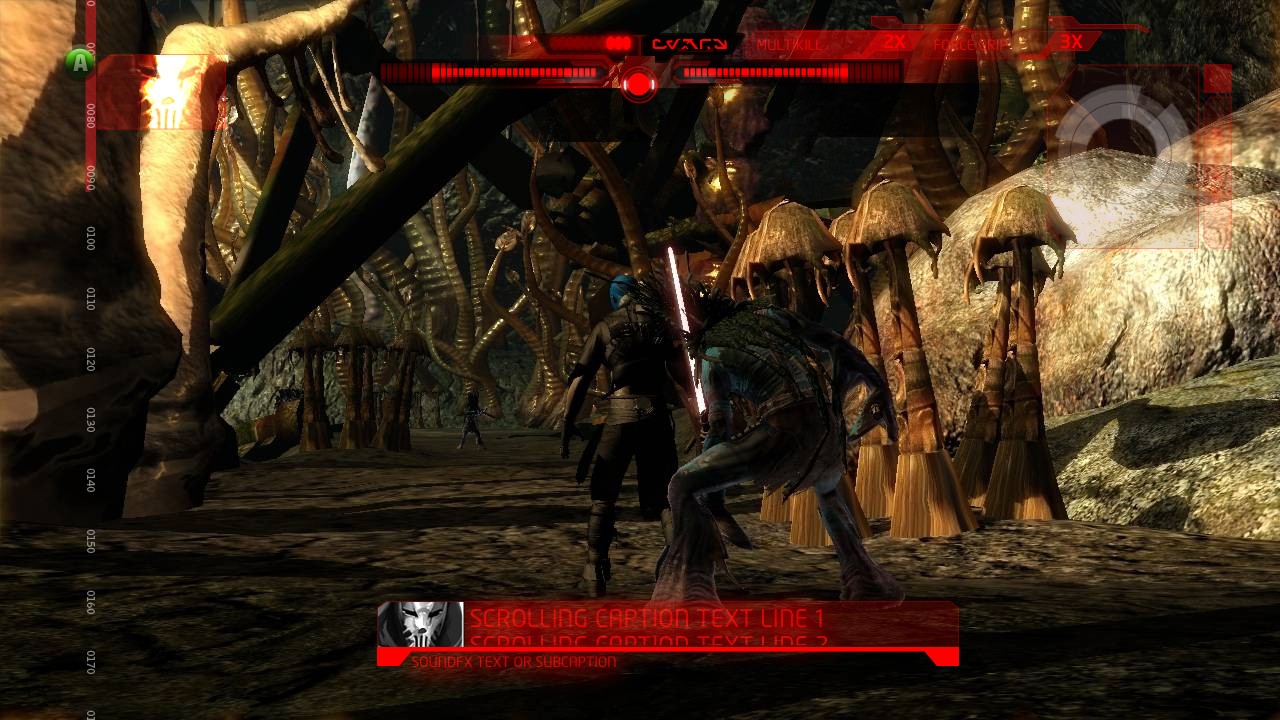
In-game UI concept for combat metering and system messages, with color coding tied to the player’s lightsaber and alignment on the light–dark spectrum.
Visual Design Gary Boodhoo
In-game UI concept for combat metering and system messages, with color coding tied to the player’s lightsaber and alignment on the light–dark spectrum.
Visual Design Gary Boodhoo
In-game UI concept for combat metering and system messages, with color coding tied to the player’s lightsaber and alignment on the light–dark spectrum.
Visual Design Gary Boodhoo
In-game UI concept for combat metering and system messages, with color coding tied to the player’s lightsaber and alignment on the light–dark spectrum.
Visual Design Gary Boodhoo
Convergence
From concept to production
Convergence
From concept to production
Convergence
From concept to production
Convergence
From concept to production
By the time the visual language was set, the work shifted from exploration to execution. The challenge was making that language hold up across real screens, controller input, localization, and performance constraints. The final front end reflects those tradeoffs: cinematic where it could be, restrained where it had to be, and reliable under the pressure of live gameplay.
By the time the visual language was set, the work shifted from exploration to execution. The challenge was making that language hold up across real screens, controller input, localization, and performance constraints. The final front end reflects those tradeoffs: cinematic where it could be, restrained where it had to be, and reliable under the pressure of live gameplay.
By the time the visual language was set, the work shifted from exploration to execution. The challenge was making that language hold up across real screens, controller input, localization, and performance constraints. The final front end reflects those tradeoffs: cinematic where it could be, restrained where it had to be, and reliable under the pressure of live gameplay.
By the time the visual language was set, the work shifted from exploration to execution. The challenge was making that language hold up across real screens, controller input, localization, and performance constraints. The final front end reflects those tradeoffs: cinematic where it could be, restrained where it had to be, and reliable under the pressure of live gameplay.
A run through of the Force Upgrade interface showing category changes, scrolling through skill trees, previewing combos, and opening modal dialogs over a procedural starfield scripted in Lua.
UI Design & Scripting Gary Boodhoo Visual Design Brian Lui
A run through of the Force Upgrade interface showing category changes, scrolling through skill trees, previewing combos, and opening modal dialogs over a procedural starfield scripted in Lua.
UI Design & Scripting Gary Boodhoo Visual Design Brian Lui
A run through of the Force Upgrade interface showing category changes, scrolling through skill trees, previewing combos, and opening modal dialogs over a procedural starfield scripted in Lua.
UI Design & Scripting Gary Boodhoo Visual Design Brian Lui
A run through of the Force Upgrade interface showing category changes, scrolling through skill trees, previewing combos, and opening modal dialogs over a procedural starfield scripted in Lua.
UI Design & Scripting Gary Boodhoo Visual Design Brian Lui
Results
The project cemented my role as someone who could design systems and help teams use them well. That experience shaped how I work: supporting collaboration, adapting to uncertainty, and turning ambitious ideas into reality.
Olaf Piesche
Staff Engineer,Shield AI
Gary is a fantastic UI and interaction designer, able to find solutions nobody else is able to see, and to improve and polish where others give up. He's very pleasant to work with and a great guy all around.
Olaf Piesche
Staff Engineer,Shield AI
Gary is a fantastic UI and interaction designer, able to find solutions nobody else is able to see, and to improve and polish where others give up. He's very pleasant to work with and a great guy all around.
Shawn McLean
iOS and Stack Developer, Therapy Muse
Working with Gary proved the point that artists and engineers can be very productive working together. We accomplished a great deal in a fairly short time span, thanks to his open mind and creative approaches to problems.
Shawn McLean
iOS and Stack Developer, Therapy Muse
Working with Gary proved the point that artists and engineers can be very productive working together. We accomplished a great deal in a fairly short time span, thanks to his open mind and creative approaches to problems.
Product Type
Videogame
Developer & PUBLISHER
Platforms
Lifecycle
Released 2008
Key Skills & Tools
In-house Game Tooling, Anark Studio, Lua Scripting, Photoshop, Illustrator, Prototyping
Credits
Game Director Haden Blackman Art Director Matt Omernick Game Design John Stafford, Rich Davis, Shawn Pitman, Cameron Suey Interface Design Gary Boodhoo, Brian Lui Visual Effects Timothy Nice Interface Engineering Stephen Schlueter, Jeffrey Pyacek, Shawn McLean Production Isa Anne Stamos, Matthew J. Fillbrandt, Julio Torres, Franklin Alioto Localization Hiromi Okamoto, Gabriel Bootz Quality Assurance Julian James, Troy Sims